
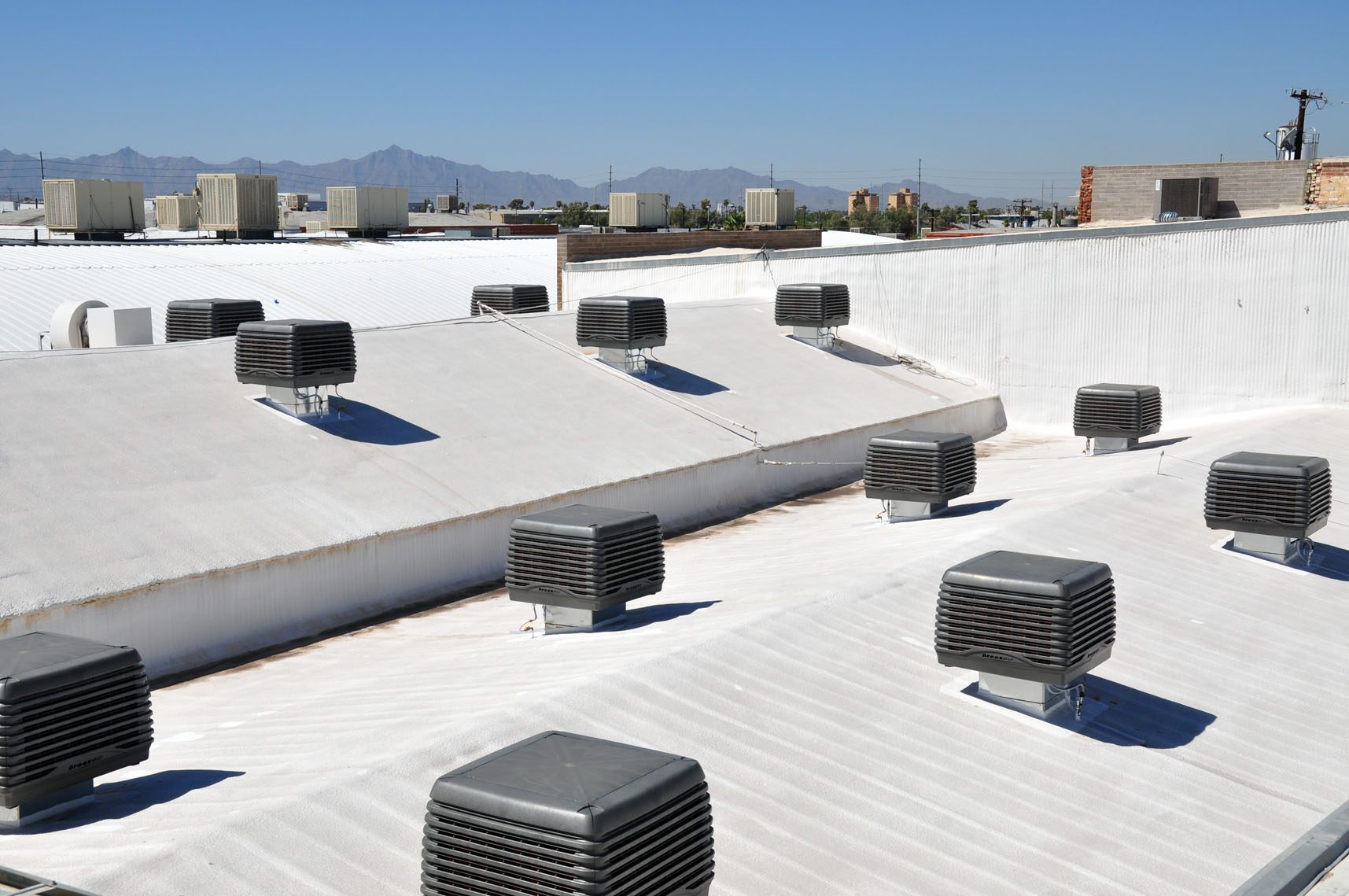
Evaporative Cooling
Evaporative coolers use water evaporation to cool the air. People have used this technique in warmer climates for many years. As global temperatures rise across Europe, more businesses are adopting evaporative cooling systems. In ancient times, Arabs used to hang wet clothes to doors and windows to take advantage of air cooling through water evaporation. As the hot air passes to the wetted media (in this case the cloth), the water evaporates. The air absorbs the heat, which lowers the air temperature.
Similarly to what occurs near lakes or the sea on the hottest days, adiabatic cooling harnesses the evaporative process of water to reduce air temperature, ensuring thermo-hygrometric comfort conditions comparable to those experienced near large expanses of water.
Saving in running costs
Evaporative cooling units only use water to cool the air. No chemical refrigerants are involved in the process. Moreover, Evaporative air conditioners use far less electricity compared to refrigerated systems: that all adds up to very responsible environmental and energy saving characteristics.
No matter how hot it gets outside, evaporative coolers use the same amount of power and still deliver 100% fresh, cool air inside. This is in direct contrast to refrigerated systems, which require increasing amounts of power as outside temperatures rise. Evaporative coolers’ cost-saving capabilities actually increase, when the heat is at its highest. At the same time, their performance also increases as temperatures rise – again, in complete contrast to refrigerated systems.
Using little electricity, no compressor and with low running costs, evaporative cooling is the perfect solution for industrial and commercial environments. These premises often have no cooling system installed at all. Air conditioning is not a viable option, because in warehouses or industrial plants, the capital and running costs would be extremely prohibitive for end-users.
Improved IAQ
Furthermore, evaporative coolers use 100% fresh outside air. Outside air ventilation is now globally acknowledged as a core component of healthy and comfortable buildings. Evaporative cooling units bring 100% fresh air, never recirculating indoor air. This can be a great solution to improve Indoor Air Quality, as incoming air naturally pushes the stale air outside of the building from doors, windows or extract system.
Evaporative Cooling Benefits Types of evaporative cooling For the harshest climates Cooling productsThe benefits of evaporative cooling are plenty. There’s never been a better time to invest in an evaporative air conditioner which is simple to maintain and operate and offers superior product performance.
With energy prices escalating and summers typically involving heat waves, evaporative cooling offers a significant and increasing edge on refrigerated cooling, when it comes to energy efficiency, healthier air flow, performance and easy install and maintenance.
Cost-effective to run
Learn more
The first thing that comes to mind when operating an air conditioner is the running cost. With modern and innovative evaporative cooling such as Breezair by Seeley International you can save up to 82% on cooling energy bills (1).
Low water Usage
Learn more
Evaporative air conditioners use a small amount of water. A Breezair evaporative air conditioner for example, uses around 40 litres of water per day (2).
By checking water saving features in different evaporative coolers, you will find that Breezair by Seeley International offers a superior water distribution system, water quality monitoring, and automatic water drainage. These features minimise water usage while maximising cooling power.
Easy maintenance
Learn more
Regular service by a qualified contractor will ensure an evaporative cooler continues to run at its peak efficiency and maintain low running costs. You can schedule an evaporative cooling service through our network of distributors.
Evaporative cooling units are also very easy to install.

Improved indoor air quality with high ventilation
Learn more
These times when the quality of the air we breathe is essential, there is nothing worse than being stuck inside breathing stale air for hours on end. Fresh air is a major benefit of evaporative cooling, supplying 100% fresh, cool, outside air.
It is important to remember that evaporatively cooled air inside a building is never recirculated, thus improving Indoor Air Quality (IAQ).

Evaporative air conditioners are enviromentally friendly
Learn more
Opting for an evaporative cooling system means that you will not only help the environment. You will also experience natural, cool, fresh filtered air. Evaporative air conditioners use far less electricity compared to refrigerated systems and therefore minimize the environmental impact.
Evaporative cooling systems do not contain harmful synthetic refrigerants. In contrast, direct expansion systems can use highly polluting greenhouse gases, such as hydrofluorocarbons or chlorofluorocarbons.
The perfect solution for industrial and commercial buildings
learn more
Evaporative coolers are ideal for big areas, even in semi-open buildings. Sometimes businesses do not install any sort of air conditioning because cooling such large spaces costs too much or internal heat-load is too high. With the evaporation process, you can cool huge areas at a fraction of the costs of A/C. This contributes to a healthy building for employees and customers. You can also decide to cool a specific section of the building where operators work or where cooling is much needed: this is called “spot cooling”.
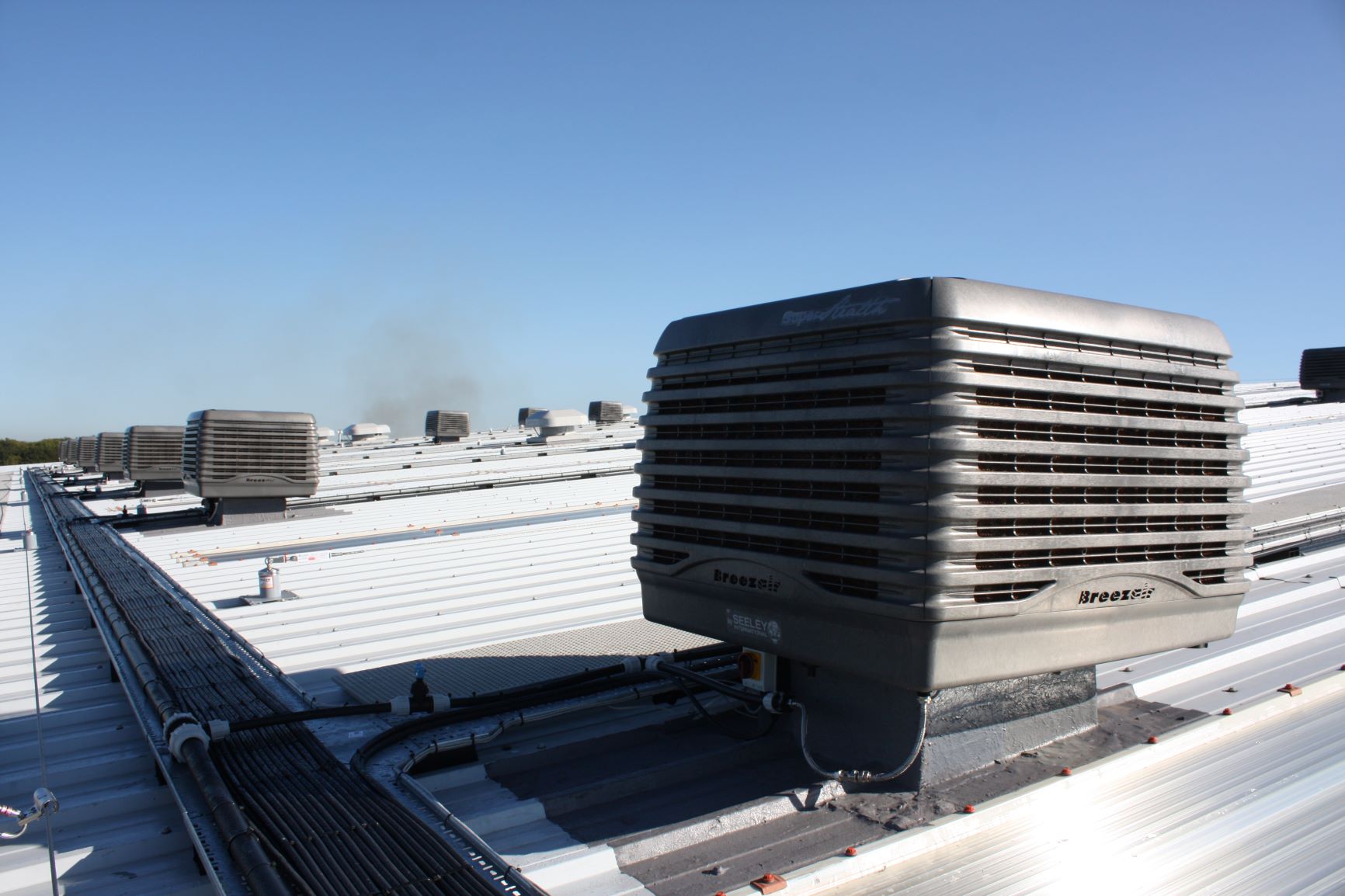
Amongst all types of evaporative cooling existing in the market, Seeley International design and manufacture Direct and Hyper-efficient Indirect Evaporative coolers.
Direct evaporative cooling
In direct evaporative coolers, a fan draws hot outside air through water-soaked cooling pads. As the air is pushed through these pads, water evaporates. The heat in the air is absorbed, which lowers the air temperature. A fan then pushes the cool air throughout the building via a network of ducts. It is called direct evaporative cooling because the air is directly cooled thanks to water evaporation.
Do you want to learn more about direct evaporative cooling? Visit our dedicated page.
Multi-cycle indirect evaporative cooling
Seeley International’s unique Multi-cycle Indirect evaporative air conditioners use a hyper-efficient heat exchanger to produce 100% fresh, cool, outside air, with no added moisture. The fresh cold air produced by this type of coolers can be similar to that produced by refrigerated systems. Its temperatures can approach the ambient dew-point temperature while using up to 80% less energy. Evaporation inside the core indirectly cools the air, therefore they are called indirect evaporative coolers.
Are you curious to understand how Multi-cycle indirect evaporative cooling works? Visit our dedicated page.
Ideal for the harshest climates
Evaporation will take place when humidity is below 100% and the air absorbs water. Any given volume of air can hold a certain amount of water vapor and the degree of absorption will depend on the amount it is already holding. When we say that Relative Humidity (RH) is 30%, we mean the air is 30% saturated. It could still hold water for a portion of 70%.
Humidity
It is the combination of temperature and humidity that creates human comfort, and Evaporative Air Coolers are used widely around the world because they can create comfortable conditions. Comfort is also improved by increasing air velocity in hot conditions, and Direct Evaporative Air Coolers create sufficient air movement to minimize the effects of humidity.
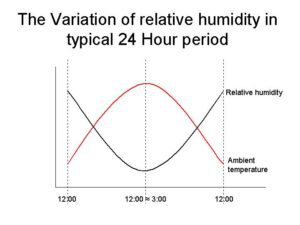 As we can see from the graph, humidity depends on temperature: when temperature is higher, relative humidity is lower. It is during these hot times that cooling is needed most, which is when evaporative coolers work at their best. This also corresponds to working hours: this is why many companies decide to adopt evaporative cooling.
We said that outside air is pushed inside the building, and doors and windows must be left open for air to escape (or extract fans installed). This also pushes out air saturated with water (with high humidity), as part of the natural flow of healthy outside air that blows inside the building.
Finally, Hyper-efficient indirect evaporative coolers do not add humidity to the air.
Climate suitability
We would normally think that evaporative cooling works in dry Southern European climates or in desert areas of Arabic peninsula. In fact, evaporative cooling works perfectly in cities like Madrid, Seville, Riyadh or locations like Southern-Continental Europe or continental Middle East. Nevertheless, there are hundreds of units that companies have installed in Northern Europe, for example Belgium or Poland, that we consider humid climates. And…they work perfectly! It is all about choosing the right application, unit and properly size the project, both in terms of number of units and extract system.
For all these reasons, evaporative coolers can be perfectly suitable for all climates. We just need to be aware of its limitations and installation/commissioning should be supervised by a trusted partner.

Better for the environment
Evaporative coolers use water for cooling instead of synthetic chemical refrigerants (CFC’s, HFC’s and HCFC’s). There are no CFC pollutant emissions from evaporative air conditioning and water consumption is moderate. That all adds up to very responsible environmental and energy saving characteristics. Evaporative coolers use far less electricity compared to refrigerated systems. Therefore, less fossil fuels such as coal and natural gas are consumed in the production of electricity.
For example, direct evaporative coolers by Seeley International absorb 1.2 kW power3 to work: less than a hair drier!
Better for health
Nowadays, more than ever, Indoor Air Quality is essential for any workplaces.
Drawing fresh air from outdoors, evaporative cooling offer a great health advantage over refrigerated air conditioning, which recirculate the same stale air over and over. Moreover, direct evaporative cooling units provide humidification of the air, relieving dry nose and throat symptoms and asthma. Working in hot temperatures often causes heat stress. In some cases, it can cause fainting, and in rare (but not negligible) cases, heat stroke. Improving temperatures in companies is therefore necessary and mandatory.
Are you curious to see how ventilation is important to improve Indoor Air Quality? Have a look at our article “Building ventilation and Covid19 containment guidances”
References:
- Seeley International’s running costs comparison is a calculation based on assumptions including Building dimensions 1000m2 floor area x 6m high; Cooling time 12hrs/day, 6 summer months/year; Indoor temperature 22°C; Building heat load 100W/m²; Rooftop Unit – Fresh air 1,170 l/sec (20%); Rooftop Unit -COP 3; External ambient conditions based on Typical Meteorological Years (TMY) for Madrid (Spain); Power cost 0.11 €/kWh; Water cost 1.5 €/m³; Electricity Generation CO2 equivalent 340gCO2eq/kWh. The comparison should be used as a general guide only.
- Seeley Internal calculation based on TBS580 running 12 hours per day for 7 months. Location: Central Europe.
- For all power consumption, see Breezair technical sheets.